Truly offline
Your backup data is processed locally, and recovery works offline. Your backup is paper you can hold.
Offline-first backups
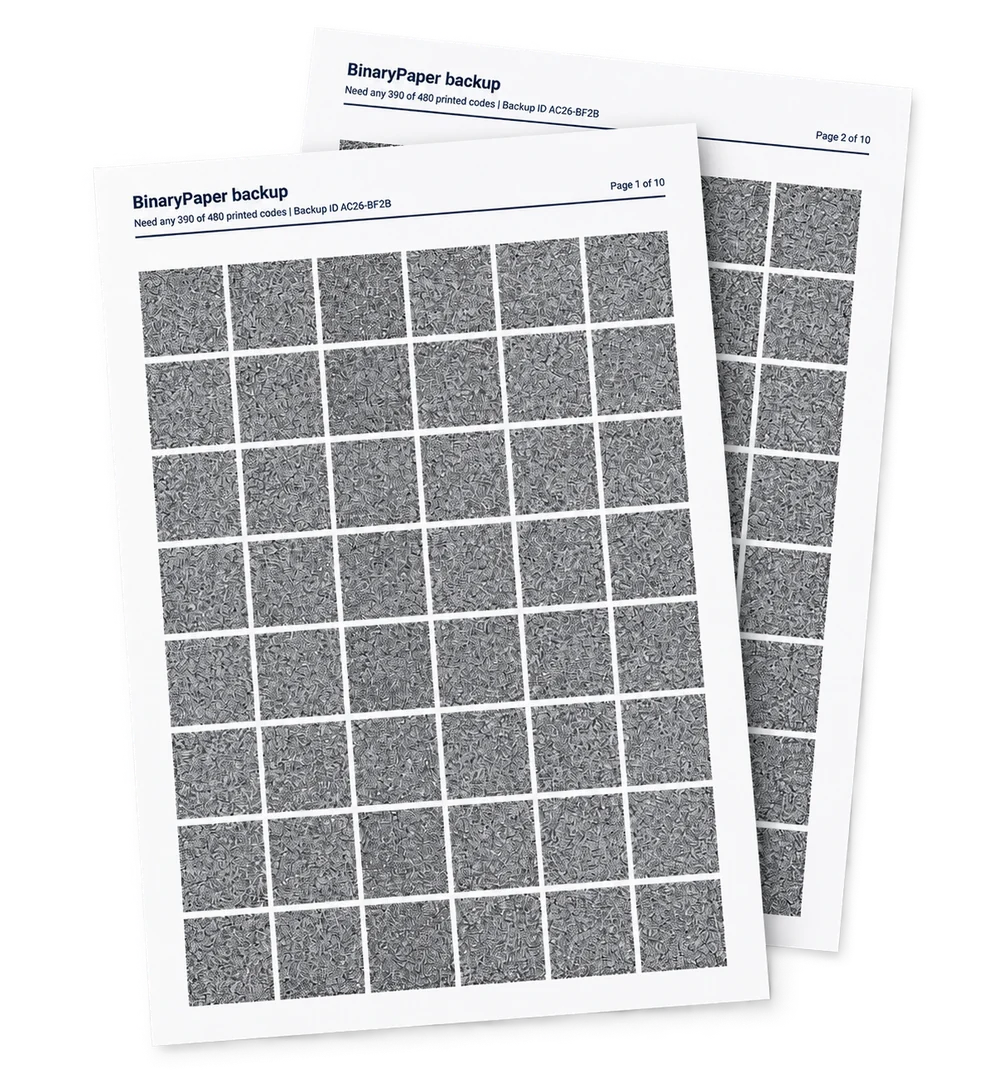
BinaryPaper turns any file into error-corrected pages you can print on plain paper. Keep them in a drawer, a safe, or a book — then recover everything later with your camera.
Local processing. Offline recovery. No lock-in.
Features
Paper doesn't need power, firmware, or a cloud service in ten years.
Your backup data is processed locally, and recovery works offline. Your backup is paper you can hold.
Every backup prints repair data alongside your content, on top of each code's own QR correction, so smudged, creased, or missing pages can still be recovered. Reed–Solomon covers ordinary backups; multi-megabyte ones switch to a code built for that scale.
Scan the printed pages with your phone to reconstruct the original file, byte for byte.
Plain black-and-white printing on standard paper. Archive it however you like.
No BinaryPaper build may print a format version until its specification, conformance vectors, and an independent recovery tool are published. Your pages do not depend on us still being here.
binarypaper-recovery on GitHub →The Android app runs the whole loop — choose your content, print the pages, and scan them back when you need them. Desktop apps are on the way.
How it works
Three steps. The hard part — splitting, error-correcting, and reassembling — happens for you.
Choose a file. BinaryPaper splits it into chunks, adds error-correction data, and lays out scannable pages.
Print the pages on any printer with plain paper. Store them anywhere — a binder, a safe, an envelope.
Point your camera at the pages. BinaryPaper reads the codes, uses the printed repair data to cover what is damaged or missing, and rebuilds the original file.
FAQ
Between about 2 KB and 170 KB on an A4 sheet. 2 KB is the out-of-the-box figure; running the built-in density test to calibrate your own printer and camera is worth roughly 20×. There is no fixed total-size limit — BinaryPaper plans the real page count from your paper, your calibration, and your reliability answers, and shows it before you print.
Repair data is spread across the whole backup, not just within a page. Each printed code carries its own QR error correction for stains, folds, and small tears, and the repair data on top of that covers codes lost outright. The summary shows the tolerated loss — how many printed codes can go missing — before you commit the backup to paper.
No. Any black-and-white printer and a phone camera work, on plain paper. Running the built-in density test on your own printer is what unlocks the higher capacities, and it costs one printed test sheet.
Restoring never does. Every recovery method is free and works offline, including for backups created with PRO. Creating is free for one file or text note up to 32 KB after compression, with the same encryption, redundancy, calibration, and verification PRO gets. PRO is a one-time lifetime purchase that lifts the size limit and adds multi-file and folder backups, manual controls, extra paper sizes, and multiple saved calibration profiles.
No. The printed format is published with conformance vectors and a recovery tool that is not this app, so anyone can rebuild a BinaryPaper page without us. Recovery stays free and offline, and never requires a purchase or an account — including for backups created with PRO.
Get BinaryPaper
Create, print, and restore backups on Android. Free up to 32 KB per backup; PRO is a one-time purchase.
Coming soonWindowsmacOSiOSLinux